Applying for a home loan is one of the biggest financial decisions most Indians make — and your bank statement is one of the most heavily scrutinised documents in the process. Lenders use 6 to 12 months of bank statements to verify your income, assess your existing obligations, evaluate your financial discipline, and confirm that your declared income matches actual cash flow.
This guide explains exactly what banks and NBFCs look at when they review your statement, what patterns trigger rejection or additional queries, and practical steps you can take before submitting your application to strengthen your case.
Why Lenders Need Your Bank Statement
A bank statement is the most reliable evidence of your actual financial behaviour — more reliable than pay slips, which can be manipulated, and more detailed than CIBIL reports, which show obligations but not cash flow. Lenders use it to answer three core questions:
- Can you afford the EMI? Your net monthly credits minus existing EMI outflows must comfortably cover the proposed new EMI — typically lenders require a Fixed Obligation to Income Ratio (FOIR) below 50–55%.
- Is your income stable? Regular, consistent salary or business income credits over 6–12 months signal employment stability. Irregular or declining credits raise questions.
- Do you manage money responsibly? Patterns like bounced cheques, frequent overdrafts, or a consistently low balance suggest financial stress — even if your income is adequate.
How Many Months of Bank Statement Do Banks Require?
| Lender Type | Minimum Statement Period | Preferred Period | Notes |
|---|---|---|---|
| Public sector banks (SBI, PNB, Canara) | 6 months | 12 months | SBI HomeLoan requires 6 months minimum; longer for self-employed |
| Private banks (HDFC, ICICI, Axis) | 6 months | 6–12 months | HDFC and ICICI often request 12 months for self-employed borrowers |
| Housing Finance Companies (LIC HFL, HDFC Ltd) | 6 months | 12 months | Stricter analysis; may ask for 24 months for business owners |
| NBFCs (Bajaj, Tata Capital, Piramal) | 3–6 months | 6 months | Faster processing; may accept 3 months for salaried at lower loan amounts |
| Cooperative banks / small finance banks | 6 months | 12 months | Varies by institution; rural cooperative banks may require passbook |
Rule of thumb: Always submit 12 months of statements if you can. A longer history gives the lender more confidence in income stability and reduces the chance of a request for additional documents mid-process.
What Lenders Check in Your Bank Statement
1. Salary / Income Credits
The lender looks for a regular, consistent credit each month from the same source — ideally on the same date or within a 3–5 day window. For salaried applicants, the credit must match the net salary declared on your pay slip (within a 5–10% tolerance for TDS deductions). For self-employed applicants, the lender looks at total monthly inflows and compares them against ITR-declared income.
2. Existing EMI Outflows
Every recurring debit that is a fixed obligation — personal loan EMI, car loan EMI, credit card minimum payment, existing home loan EMI — is added up to calculate your current FOIR. The lender then adds the proposed new home loan EMI to this number and checks whether the total stays under their threshold (typically 50% of net monthly income).
3. Average Monthly Balance (AMB)
Lenders calculate your average end-of-day balance over the statement period. A consistently healthy AMB (generally 2–3x the proposed EMI amount) signals that you do not live paycheque-to-paycheque and have a buffer for financial emergencies. A very low AMB — especially one that regularly dips below ₹5,000 — is flagged even if your income credits are adequate.
4. Cheque Returns / ECS Bounces
A bounced ECS or cheque return entry is one of the most damaging signals in a bank statement review. It indicates either insufficient funds or poor cash flow management. Most lenders will not reject for a single bounce in 12 months if the reason is explainable, but 2 or more bounces in 6 months is a significant red flag and may trigger an outright rejection or an increase in the interest rate offered.
5. Cash Deposits
Large, irregular cash deposits — especially those that appear just before the application — are scrutinised carefully. Lenders suspect these represent borrowed funds inflated to show a higher balance. Cash deposits exceeding ₹50,000 in a single transaction, or ₹2 lakh cumulatively in a month, require explanation. If you are a business owner with legitimate cash sales, maintain proper books that can be shown alongside the statement.
6. Inward Remittances / UPI Credits
Frequent inward UPI transfers from multiple individuals (not a salary account) are sometimes treated as informal borrowing, which increases the lender's risk assessment. If you receive legitimate rent income or family transfers, be prepared to explain these with a brief letter and supporting documents.
Red Flags That Cause Loan Rejection or Queries
| Red Flag | Why Lenders Care | Mitigation |
|---|---|---|
| 2+ ECS / cheque bounces in 6 months | Signals insufficient funds or poor cash management | Explain the bounce in a covering letter with supporting evidence (medical emergency, salary delay, etc.) |
| Salary credit missing for 1–2 months | Raises doubt about employment continuity | Attach employer letter confirming employment and reason for gap (sabbatical, job change, etc.) |
| Large unexplained cash deposits | May suggest informal loan or undeclared income | Provide cash deposit slips, sales records, or a CA certificate for business income |
| Balance consistently below 2x proposed EMI | Low liquidity buffer raises repayment risk | Try to increase your AMB for 3–6 months before applying; reduce unnecessary outflows |
| Multiple personal loan / BNPL EMIs | High existing FOIR reduces eligibility for the home loan | Close small personal loans or credit card EMIs before applying |
| Salary account different from statement bank | Lender may ask for the primary salary account statement | Submit statements for all active accounts; the salary account is most important |
| Overdraft usage on savings account | Signals dependence on credit for routine expenses | Avoid overdraft in the 6 months before applying |
How to Prepare Your Bank Statement for Home Loan Application
- Use your primary salary account: The account your employer credits every month should be your submission account. If your salary goes to Account A but you spend primarily from Account B, submit both.
- Download the full 12 months: Even if the lender asks for 6, submit 12. A longer window shows more stability and reduces the chance of adverse transactions appearing at the edges of a shorter window.
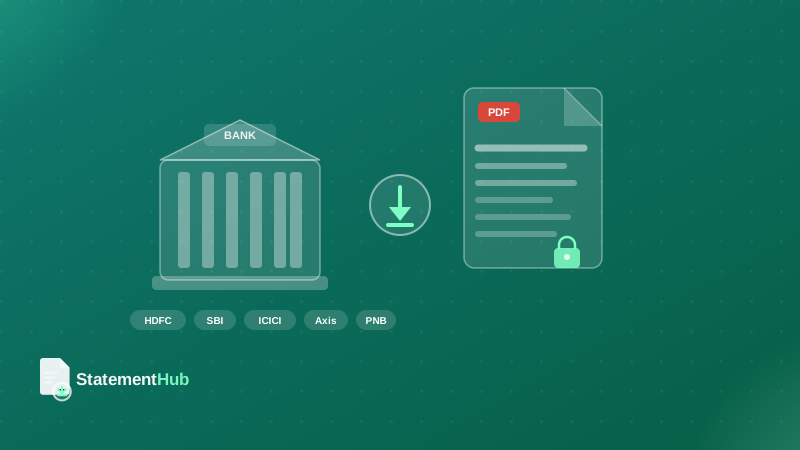
- Download from net banking, not the mobile app: Net banking always generates text-based PDFs. Mobile app PDFs on older devices can be image-based, which makes them harder to verify and may require resubmission.
- Do not modify the PDF: Any modification — even a redaction or highlight — can invalidate the document's digital signature. Submit the PDF exactly as downloaded.
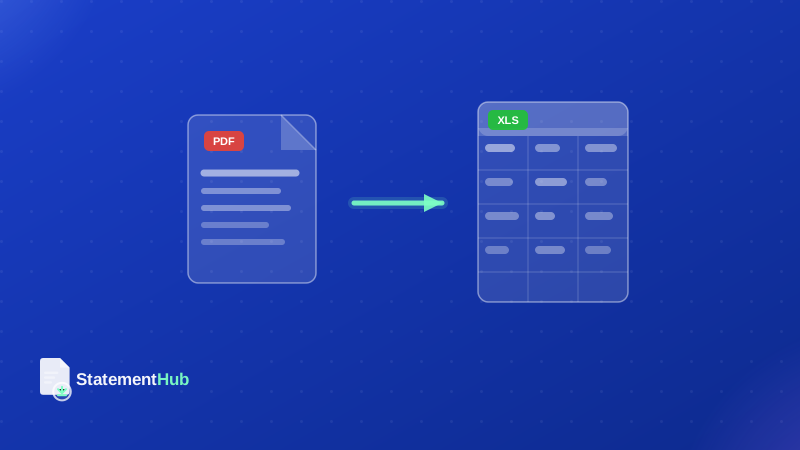
- Convert to Excel for your own analysis first: Before submitting, convert your statement to Excel and calculate your own FOIR. Know the number before the lender sees it.
- Write a covering note for unusual transactions: If there are cash deposits, salary gaps, or bounces, include a covering letter explaining them. Lenders appreciate transparency — it prevents back-and-forth during processing.
Convert Your Statement to Excel — Analyse Before You Submit
Before handing your statement to a bank or housing finance company, analyse it yourself. Converting the PDF to Excel lets you calculate your own Average Monthly Balance, identify all outgoing EMIs, flag any ECS bounces, and understand exactly what a credit officer will see.
StatementHub converts Indian bank statement PDFs — including password-protected ones — to clean Excel files in under 60 seconds. No login, no server upload, works entirely in your browser. Compatible with HDFC, SBI, ICICI, Axis, PNB, Canara, Bank of Baroda, and 50+ other banks.
- Visit statementhub.in and upload your bank statement PDF.
- Enter your bank's PDF password if prompted (see our password guide for each bank's formula).
- Click Convert and download the Excel file.
- In Excel, filter for "ECS RETURN" or "CHQ RETURN" to spot bounces instantly.
- Sum all outgoing EMI columns to calculate your current FOIR before the new EMI.
- Calculate average of the closing balance column to get your AMB.
Bank-Wise Statement Requirements for Home Loans
| Bank / Lender | Period Required | Format Accepted | Specific Notes |
|---|---|---|---|
| SBI HomeLoan | 6 months (12 for self-employed) | PDF (net banking download) | Passbook printout accepted for rural branches; digital preferred |
| HDFC Bank Home Loans | 6–12 months | PDF or bank-stamped print | Salary account statement preferred; NRI applicants need NRE/NRO statement |
| ICICI Bank Home Finance | 6 months salaried, 12 months self-employed | iMobile Pay PDF accepted; NRO/NRE accepted for NRI loans | |
| Axis Bank Home Loans | 6 months | Burgundy account holders may get relaxed FOIR norms | |
| LIC Housing Finance | 6 months | PDF or passbook | Strict on ECS bounce — even 1 bounce in 6 months triggers a query |
| Bajaj Housing Finance | 3 months salaried, 6 months self-employed | Faster approval if statement shows salary above ₹50,000/month | |
| PNB Housing Finance | 6 months | Former OBC or United Bank account statements accepted post-merger |
Frequently Asked Questions
Can I submit a passbook instead of a bank statement for a home loan?
Some public sector banks — especially for rural or semi-urban applicants — still accept a bank-stamped passbook printout. However, most private banks, housing finance companies, and NBFCs require a digitally downloaded PDF statement with the bank's watermark intact. Always ask your loan officer which format they accept before visiting the branch.
Will one ECS bounce disqualify my home loan application?
Not automatically. A single ECS bounce in 12 months is generally not a deal-breaker if your income, CIBIL score, and overall financials are strong. However, if the bounce coincides with a low balance period or if there are other risk signals, a credit officer may flag it. Include a brief explanation letter with your application to prevent unnecessary delays.
What FOIR is acceptable for a home loan?
Most lenders in India cap FOIR at 50–55% of net monthly income. This means if your net salary is ₹80,000 per month, your total fixed obligations (all EMIs including the new home loan EMI) should not exceed ₹40,000–₹44,000. Some lenders offer relaxed FOIR up to 65% for applicants with very high incomes (above ₹1.5 lakh/month) or strong credit profiles.
Do I need to submit statements for all my bank accounts?
You must submit the statement for your primary salary account — the one that receives your regular income credit. If you maintain multiple accounts and operate them actively, the lender may ask for statements from all of them to get a complete picture of your obligations. A dormant account with no activity can be declared but does not require a statement.
Can I get a home loan if I have been self-employed for only 1 year?
Most lenders require a minimum of 2–3 years of self-employment history for home loan eligibility. With only 1 year of business history, you may face rejection from large banks. However, some NBFCs and small finance banks are more flexible — they may accept 1 year of ITR plus 12 months of bank statements showing strong and consistent business inflows.
How do I convert my bank statement PDF to Excel for FOIR calculation?
Use StatementHub — free, no login, runs in your browser. Upload your bank statement PDF (password-protected PDFs are supported), select your bank, and download a clean Excel file with proper columns. Then sort by the Debit column, filter for recurring fixed amounts, and add them up to get your total monthly EMI obligations.
Conclusion
Your bank statement is not just a formality in the home loan process — it is the primary document that determines how much you can borrow, at what rate, and whether you get approved at all. Lenders check income stability, FOIR, average balance, and financial discipline across 6–12 months of transactions.
The best preparation is transparency and advance analysis. Download your last 12 months of statements, convert them to Excel, calculate your own FOIR, identify any red flags, and address them with supporting documents before you submit. A well-prepared application moves faster and avoids back-and-forth with the credit team.
Analyse your bank statement before your lender does. Visit StatementHub — convert your HDFC, SBI, or ICICI statement to Excel in under 60 seconds. Free, no login, nothing uploaded to any server.